Is Taboola Ads Safe, Secure & Legit? (The Full Facts)

Taboola Ads security holds up well under scrutiny. The company is public, trades on Nasdaq, and carries ISO 27001 and ISO 27701 certifications. It also publishes its policies, billing terms and privacy program for anyone to read. The real question is not whether Taboola is safe. It is whether your budget and traffic quality hold up once a campaign runs.
Why Trust Our Taboola Ads Read
Our 28 specialists bring over 190 combined years of work. Together we have run more than 180 campaigns across 14 industries. We have watched native ad budgets behave in the real world, not on a vendor slide. That gives our read on Taboola Ads security some weight.
Need Help Vetting Taboola Ads?
Our Taboola Ads management team reviews accounts before spend goes live. We flag settings that quietly leak budget. No vendor holds a stake in our business, so the read stays independent. Get in touch for a second opinion.
Is Taboola Ads Run by a Legitimate Company?
Yes, Taboola is a public company that publishes its filings, certifications and policies. Anyone can check them without calling a sales rep, and the paper trail settles the legitimacy question quickly.
The Taboola Ads Company Record at a Glance
| Company detail | What the public record shows | Why it matters to an advertiser |
|---|---|---|
| Headquarters | New York City, United States | US contract and consumer law covers your account |
| Ownership | Public company, Nasdaq ticker TBLA | Financials and disclosures are filed, not self reported |
| Founder and chief executive | Adam Singolda | Leadership has stayed with the company since launch |
| Reported annual revenue | About $1.9 billion | Not a thin company likely to vanish mid campaign |
| Route to public markets | SPAC merger with ION Acquisition Corp, valued near $2.6 billion | The valuation and merger terms are public record |
| Notable acquisition | Connexity, an ecommerce ad platform, for $800 million | Signals a funded balance sheet behind the product |
| Security certifications | ISO/IEC 27001 and ISO/IEC 27701 | Outside auditors check its security and privacy work |
| Industry bodies | Member of the DAA, the IAB and the NAI | Binds the network to shared advertising standards |
Taboola holds an A- rating from the Better Business Bureau. The company is not BBB accredited. It carries one complaint marked unanswered. When we vet a native network against options like other native ad platforms, that company record is the first thing we pull.
Worth knowing: Legitimacy and satisfaction are two different questions. People mix them up constantly. Taboola clears the legitimacy bar without much argument. Almost all the online criticism is about performance, billing surprises and slow support. It is rarely about whether the company behind the ads is real.
Is Taboola Ads Secure and Safe to Use?
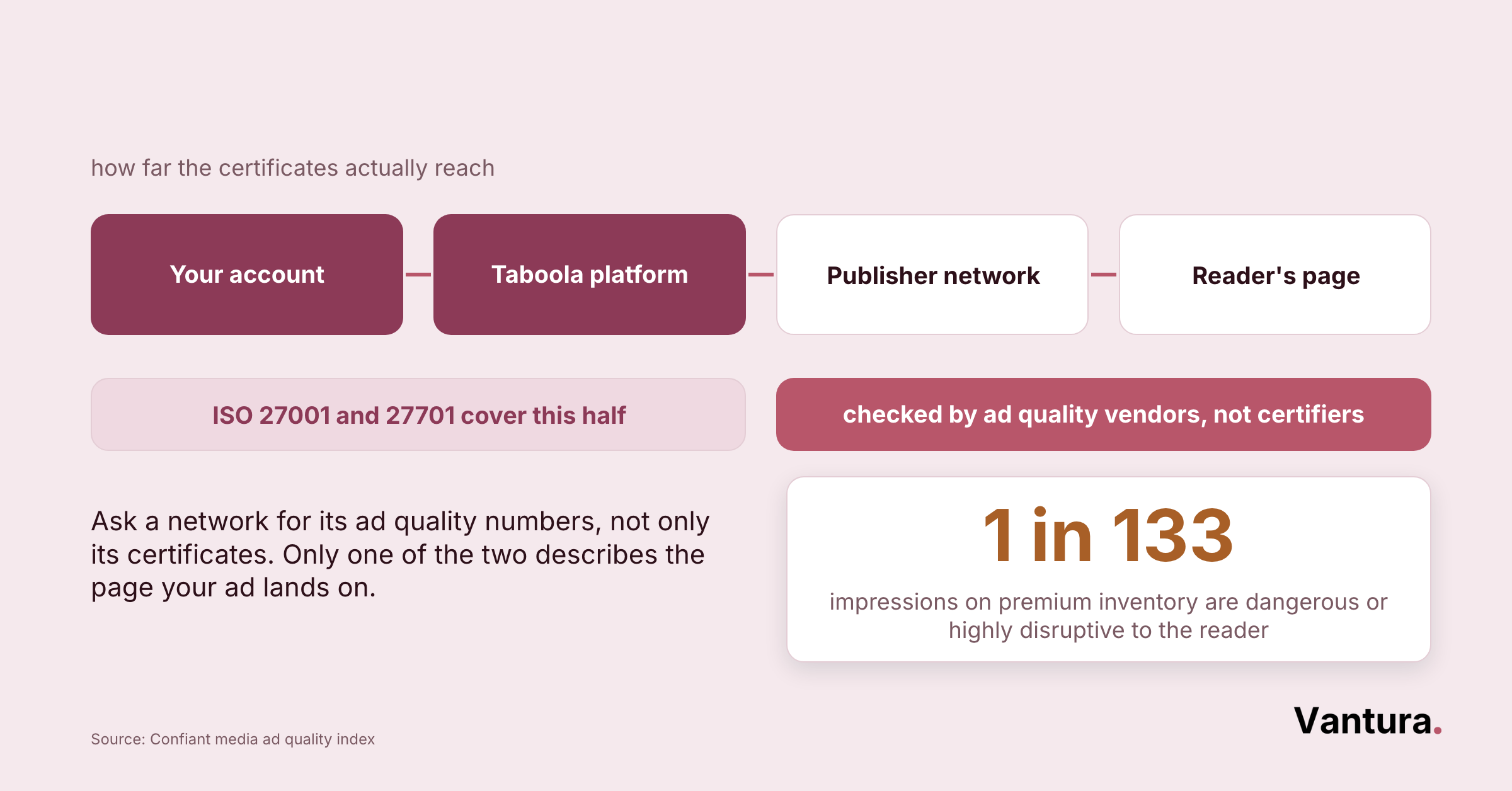
Yes, on the technical side. Taboola holds ISO/IEC 27001 for information security. It also holds ISO/IEC 27701 for privacy management. Outside auditors check both, not Taboola itself.
Its Trust Center describes a privacy by design approach. It names a data protection officer. It lists regular third party compliance audits too. Privacy staff train through the International Association of Privacy Professionals and hold CIPP/E credentials.
That is a fuller disclosure than many mid sized ad networks publish at all. It matters most when a legal team signs off on every vendor. That review step is routine when we set up Taboola ads for finance brands
None of it covers campaign level safety, though. Certificates protect the data pipe, not your budget. Those are separate problems with separate fixes.
The short version: Taboola Ads clears the standard security checks a data conscious advertiser would ask about. ISO 27001, ISO 27701, a data protection officer and outside audits are all public record. Safety problems on Taboola are rarely about the tech. They are about what your money buys.
Is Your Data Safe With Taboola Ads?
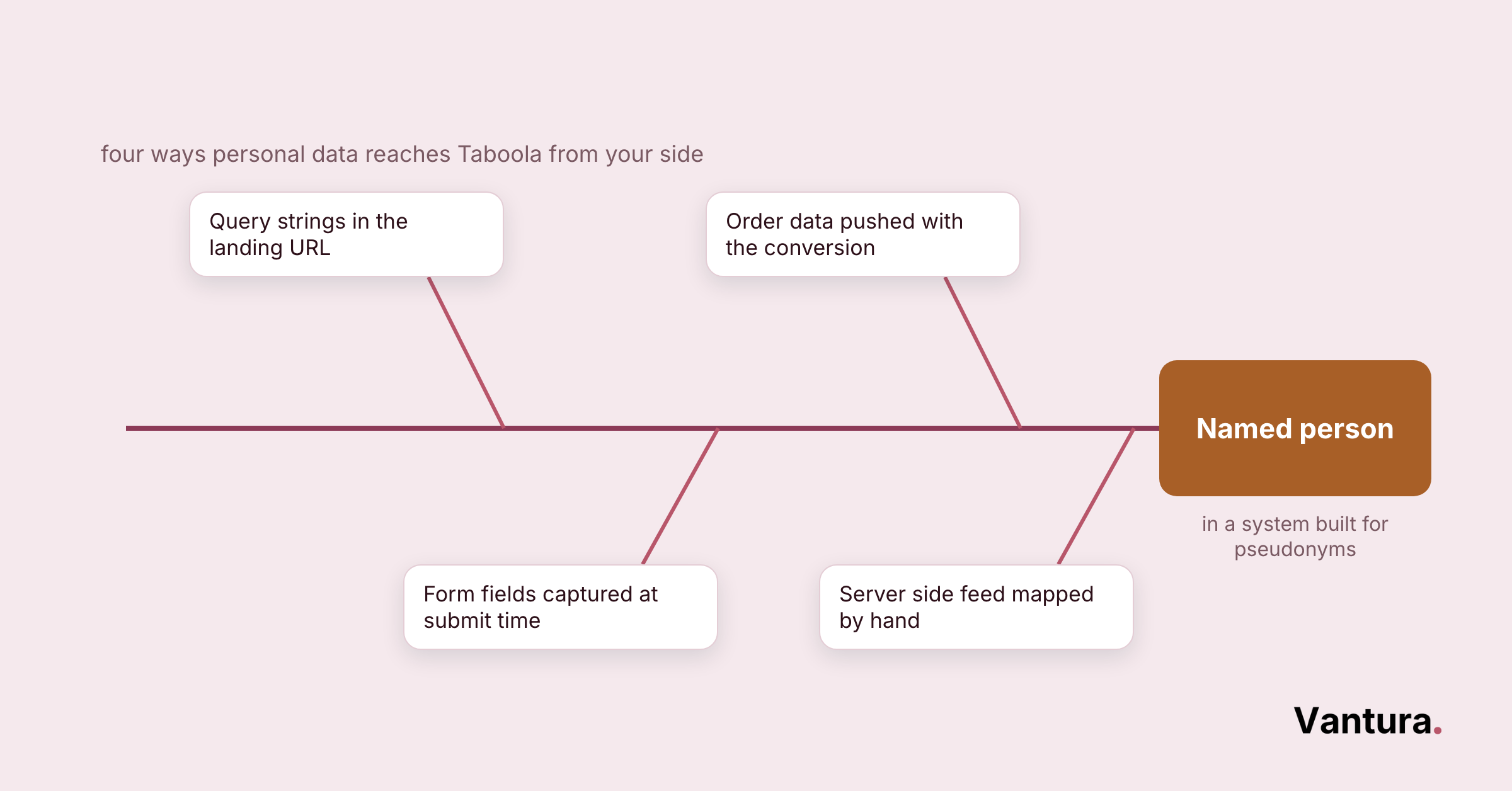
Mostly, yes. The key detail is how little Taboola holds in the first place. It says it works with pseudonymized data, not names or email addresses. That limits the damage any one failure could do.
- ISO/IEC 27701 certification covers the privacy management system
- A data protection officer and an internal GDPR team are in place
- Regular security checks look for weak spots
- A US State Consumer Rights Portal handles CCPA and CPRA requests
- The IAB Multi State Privacy Agreement and Global Privacy Platform carry Do Not Sell signals
- Point of collection notices go out where local rules require them
For regulated advertisers, this carries more weight than the marketing copy suggests. We see the same pattern running Taboola ads for health brands. Compliance review can stall a launch for weeks without the right vendor paperwork.
Keep in mind: Taboola says it collects pseudonymized data only. It is not sitting on your customers’ names or inboxes. Your own pixel and conversion feed are the bigger risk. That is where personal data leaks if someone sets it up carelessly on your side.
How Reliable Is Taboola Ads Really?
Delivery is reliable. Serving works. The dashboard reports on time. Platform outages are not a common complaint.
Results are the unpredictable part. Placement quality swings by publisher. One creative can pull clean traffic from one site. The same creative can pull near worthless clicks from another.
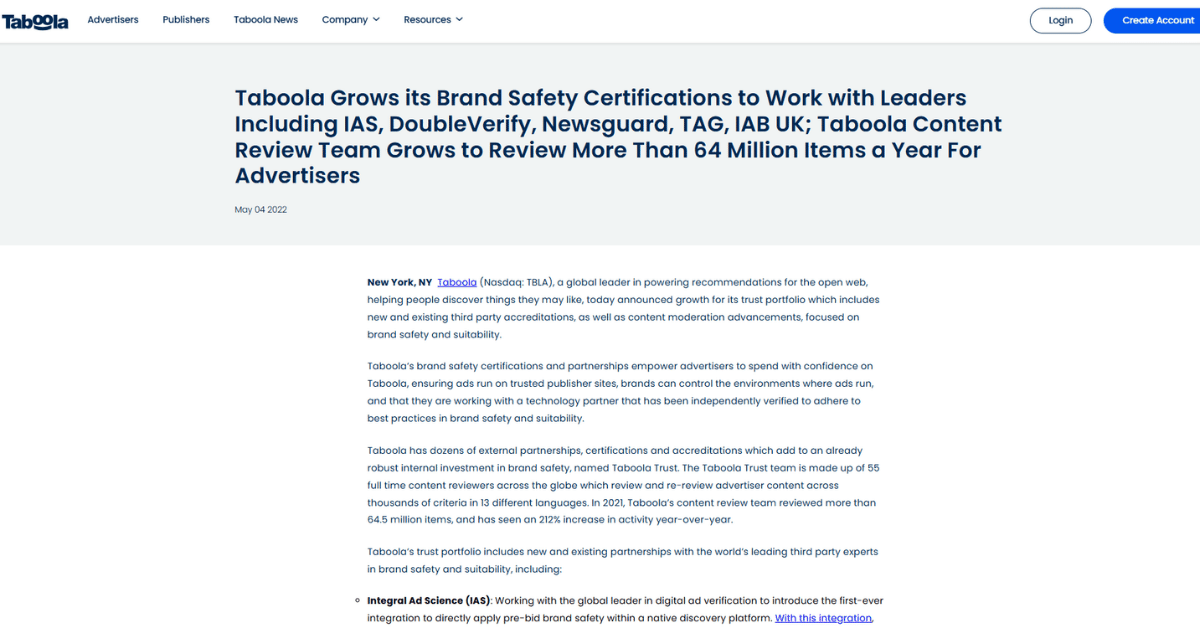
Taboola says its review team screens more than 64 million items a year. It works with outside partners too, including IAS, DoubleVerify and NewsGuard
Screening supply is not the same as guaranteeing it. Monitoring still stays your job.
The Reputation of Taboola Ads (What People Really Think)
Reviews split hard. The split follows who is talking. Advertisers with volume and patience rate Taboola far better. Small budget testers rate it worse.
Publishers form a third camp, with complaints of their own. Everything below is user reported sentiment, not anything we checked ourselves. Read it as a pattern, not a finding.
Where Taboola Ads Earns Its Better Reviews
The kinder reviews cluster around reach. Taboola puts you in front of readers who are not searching and not scrolling social. That is a genuinely different audience pool.
Scores reflect that split. The Realize platform page on G2 sits near 3.7 out of 5 from 67 reviews. The older Taboola sellers page sits near 2.9 out of 5 from 30 reviews. The newer platform reviews run meaningfully warmer than the older ones.
Reviewers on G2 who rate the platform highly tend to cite reach. They also cite the volume of placements available outside search and social. Source: G2.
The Complaints That Come Up Again and Again
The loudest advertiser complaint is paying through a learning period with little to show for it. People expect a test budget to produce a signal. The first stretch often produces spend and little else.
Taboola sits at 2.7 out of 5 on Trustpilot, which the site labels poor. Our Taboola Ads consulting work points to a cause. Unclear expectations cause about as much of that anger as the product does.
The recurring Trustpilot theme is getting charged through an unclear learning phase before any real result shows up. Source: Trustpilot.
Where Taboola Ads Sits in the Native Advertising Market
Taboola is one of two names that define native discovery advertising. The buyer conversation almost always comes down to Taboola against Outbrain. An earlier attempt to merge the two never closed.
That position gives it inventory reach smaller networks cannot match. It also makes Taboola the default target for blame whenever native advertising disappoints someone.
ComplaintsBoard entries cluster around account suspensions explained in vague terms. The complaints rarely target the ad product itself. Source: ComplaintsBoard.
What Publishers Say, and Why Advertisers Should Care
The harshest reviews of Taboola are not written by advertisers at all. Publishers running the widget describe withheld payments. They also describe earnings reversed over alleged policy breaches.
This matters to you too. Publisher churn changes your inventory. Sites that leave the network take their audience with them. Your best performing placement can quietly disappear.
Publisher threads on BlackHatWorld describe payments held back. They also describe revenue clawed back over disputed policy violations. Source: BlackHatWorld.
Reasons People Shouldn’t Use Taboola Ads
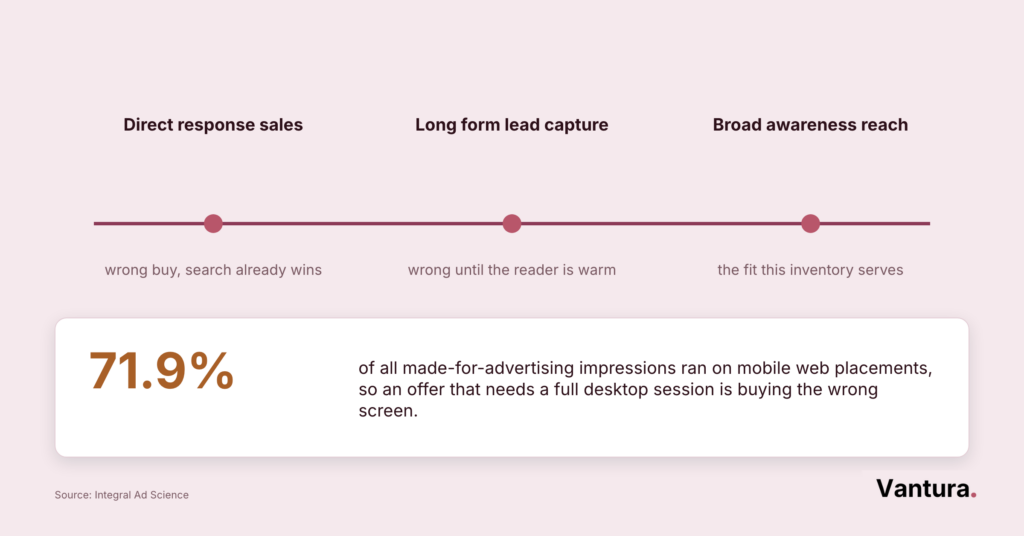
Plenty of advertisers should skip this channel. None of those reasons involve safety. They are mismatches of budget, patience or category.
- You need cheap traffic out of a small test budget
- You cannot wait out a learning period before judging results
- You sell in a category the network bans outright
- You have nobody to build and prune site blocklists weekly
- You rely on last click reporting to justify every channel
- You need a support answer in hours rather than days
- You only want bottom of funnel demand, which search already captures
- You run one landing page and cannot test creative variations
- You need guaranteed placement on named publishers
Native works as a demand creation channel, not a demand capture one. That mix up sinks more Taboola ecommerce campaigns than any platform flaw does.
Reality check: Most people who call Taboola Ads a waste of money expected search intent. They got interruption instead. The platform did what it does. The plan behind the spend did not survive contact with a real audience.
What Risks Are Associated With Taboola Ads?
The real risks are commercial and operational rather than criminal. Each one has a control you can put in place before you spend.
Risk #1: Budget burn while the campaign learns
Bidding runs on cost per click or cost per thousand impressions. Spend starts the moment delivery does. Early clicks buy you data, not customers.
Across our native campaigns we plan for three to four weeks before the numbers settle enough to judge. Advertisers who budget for one week almost always quit angry.
Risk #2: Low quality placements and made for advertising sites
In our own account audits, a meaningful share of paid impressions never reach a genuine viewer at all. Invalid traffic is a known issue across native and programmatic inventory, not a defect unique to this network.
The category has grown fast enough to attract that kind of supply. Future Market Insights values the global native advertising market at over $125.5 billion, projecting it to expand at a 21.7 percent compound annual rate toward nearly $892 billion in the years ahead, and low quality inventory tends to follow budget growth of that size.
Ads still land on thin, made for advertising pages despite the network’s brand safety claims. Those sites generate clicks that never convert.
Blocklists are the fix, and they need maintenance. Across the accounts we manage under our own Taboola Ads best practices, pruning the worst sites weekly does more for return than most creative changes.
Risk #3: Policy rejection and account suspension
Taboola’s banned content policy lists 25 categories. These cover everything from weapons and drugs to misleading claims and shock tactics. Some rules catch honest advertisers by surprise.
Suspensions with thin explanations are one of the most common complaints on review sites. Read the policy before you write the creative, not after a rejection.
Risk #4: Bad actors slipping past review
Taboola has been caught out before. Security researchers found a fraudulent advertiser that passed review. It then hid its real landing page and sent readers to fake support scam pages.
Taboola said the advertiser reached limited scale before being disabled and banned. That response was reasonable. It still shows manual review is a filter, not a wall.
None of these risks are unique to this network. They are the standard costs of buying open web inventory. They are easy to manage when someone owns them. Ignore them, and the channel will feel unsafe when it is really just untended.
The Hidden Costs of Taboola Ads Most People Miss
The rate card is not where budgets get hurt. Three costs sit outside the bid and catch people out repeatedly.
#1 The learning period you pay for twice
Every campaign restart resets what the algorithm has learned. Advertisers who pause, rebuild and relaunch pay that cost again each time.
In our experience, roughly a third of the sites that spend money in the first week never produce a conversion at all. That share drops sharply once the account has history behind it.
Why this one blindsides people
Search advertisers are used to pausing and resuming with no penalty. Native punishes stop-start behavior. The cost shows up as wasted spend, not as a fee.
#2 The management hours nobody puts in the plan
Site blocklists, creative rotation and placement review are weekly work, not a launch task. Left alone, a native account drifts toward the cheapest and worst inventory.
We budget several hours a week per account for that upkeep. Teams that skip it usually decide the channel does not work. In truth the account was simply never tended.
The reason it slips past planning
Media budgets get approved. Labor hours rarely do. A sound plan for Taboola Ads ROI prices the people alongside the placements.
#3 Billing mechanics that shape your cash flow
Taboola offers three billing methods. Automatic billing charges a card on file as spend accrues. Invoice billing needs an approved credit limit. Prepayment means funding the account by card or wire before anything runs.
None of that is hidden. All of it changes how your finance team feels the channel’s impact. Prepayment in particular ties up cash that a monthly invoice would not.
Where the surprise usually lands
Marketers pick the fastest path to launch and inherit the billing terms that come with it. Choose the method before the campaign, not during it.
How to Protect Your Budget and Brand on Taboola Ads
Most of the horror stories are preventable with settings you configure once. Treat the first month as paid research with guardrails, not as a performance campaign.
Set up the safeguards before your first click
Almost every safeguard lives in the campaign build. None of them take long to set. Skipping them is what turns a small test into a story about wasted money.
We run the same checklist on every new native account regardless of client size. It has caught more budget leaks than any reporting dashboard we have used.
- Cap the daily budget lower than you think you need
- Install and test the conversion pixel before launch, not after
- Read the banned content list against your own offer
- Pick a billing method your finance team has agreed to
- Start with a site blocklist seeded from your other channels
- Set a review date to prune placements, not just to check spend
- Keep at least four creative variations live from day one
Before you launch: Decide in advance what number would make you shut the campaign down. Write it somewhere your team can see. Advertisers who set that line before spending stay calm through the learning period. Advertisers who set it afterward usually set it in anger.
Deciding how much to risk while the account learns
The size of your test decides whether the data means anything. Too small, and you learn nothing. Too large, and one bad month sours the channel for a year.
Across our native campaigns, blocking the bottom 12 to 18 percent of sites by spend lifts conversion rate more than most creative rewrites do in the first month. That is the single highest return hour in the account. It only shows up once you have spent enough to see the pattern.
Buy data, not revenue. Keep budgets small and creative varied. Pin expectations to cost per click and click quality, not to sales.
Judge the account on which sites and which headlines survive. A test that identifies twenty placements worth keeping has paid for itself.
Now the metrics change. Cost per acquisition and assisted conversions matter. Click volume stops being an interesting number on its own.
Raise budgets in steps, not jumps. Large increases restart the learning you already paid for. Pair the growth with other channels so one network never carries the whole plan.
That pairing matters more than most teams expect. We usually run native alongside Reddit Ads management or another discovery channel. A single supply source makes results swing on decisions you do not control.
The wider view helps too. Native rarely closes a sale by itself. Solid Taboola Ads integrations give it somewhere to hand the reader off.
Honest Verdict: Should You Use Taboola Ads?
Taboola Ads is safe, secure and legitimate. It is a Nasdaq listed business with audited certifications. It publishes its policies and runs a real content review team behind the network.
Whether it suits you is a separate question. It rewards advertisers with patience, a budget that survives a learning period, and someone willing to prune placements every week.
If none of those apply, spend the money where intent already exists. If they do, a competent Taboola Ads agency will get you past the expensive part faster than a solo test will.
Bottom line: Treat safety and suitability as two separate calls. Taboola Ads passes the safety one with ease. The suitability one depends on whether you can fund a learning period and keep tending the account after.
Taboola Ads Security FAQ
If your own answer to any of these still feels uncertain, resolve that before you fund an account, not after. Get in touch and we will look at the setup with you.
Disclaimer: This post is for general information only. It reflects publicly available information about Taboola at the time of writing and is not legal, financial or security advice. Vantura Marketing is not affiliated with Taboola, and platform policies, pricing and certifications can change without notice. Verify current details with the vendor before making a decision.