Taboola Ads vs Outbrain: Which One Wins in 2026?

Taboola Ads and Outbrain both buy native placements across publisher sites, and the real split is raw reach versus publisher depth. Taboola now runs its advertiser side under the Realize name, while Outbrain trades as Outbrain Direct Response inside Teads. Which one wins comes down to whether you want volume to test into, or fewer placements that sit closer to the page.
Why Trust Us on Taboola and Outbrain
Our 28 specialists have run native campaigns across 14 industries, from finance to retail. Between them they’ve delivered more than 180 campaigns and 750 A/B tests, so this comparison comes from spend. No vendor holds a stake in us.
Need Help Choosing Between Taboola and Outbrain?
We can read both accounts, tell you where the budget belongs, and hand back a plan you run yourself. Or we take it on as ongoing Taboola Ads management. Get in touch and we’ll size it up.
Taboola Ads vs Outbrain at a Glance
Both networks sell the same basic thing. You pay to put a headline and a thumbnail on someone else’s article page, and you hope the click is worth it.
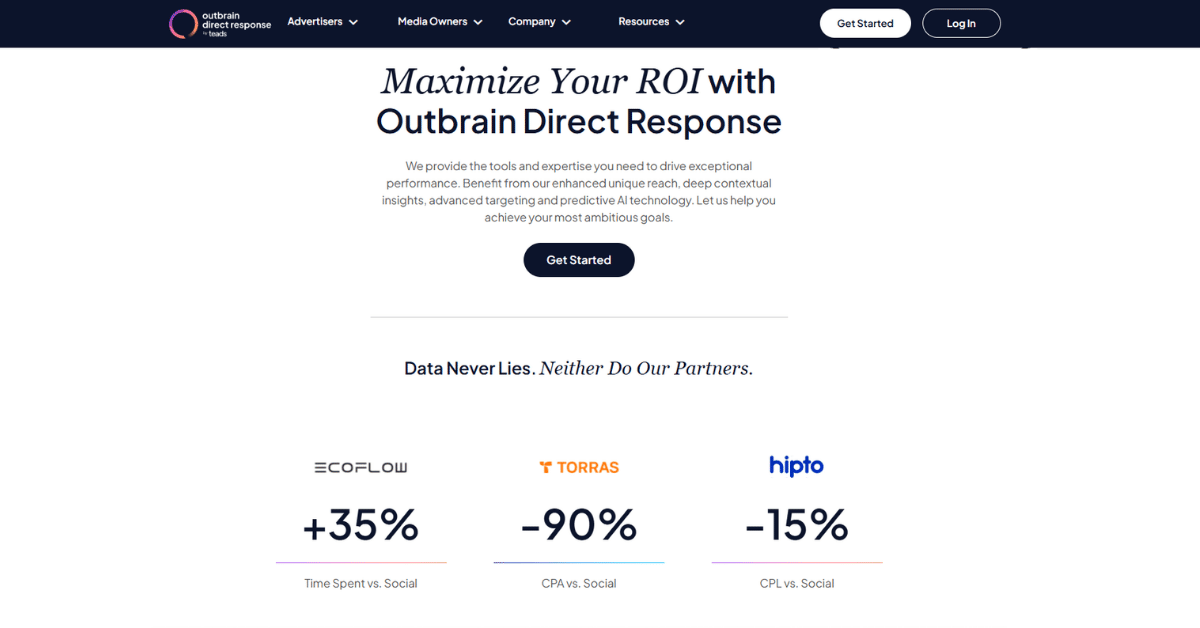
The names have moved around, though. Taboola’s advertiser product is called Realize now, and Outbrain sells as Outbrain Direct Response after the Teads merger.
Underneath, the buying job is close to identical. What differs is how much inventory you can reach and how much control you get over where the ad lands.
Short version: Taboola Ads and Outbrain do the same job with different centers of gravity. One leans on open scale and automation, the other on deep publisher integrations. The choice usually follows how much inventory control your offer needs, not which brand you recognize.
Taboola Ads vs Outbrain Comparison Table
| What you’re comparing | Taboola Ads (Realize) | Outbrain (Outbrain Direct Response) |
|---|---|---|
| Advertiser brand | Realize, Taboola’s self serve advertiser product | Outbrain Direct Response, a subsidiary of the new Teads |
| Ad formats | Native, display, social creative, vertical video, carousel, motion, app promotion | Clip, App Install, Carousel, Standard Native |
| Publisher access | Vetted publisher network with proprietary first party publisher data | Code on page integrations with 10,000 media partners |
| Targeting approach | AI audience matching, high intent identification, consideration and conversion funnel targeting | Contextual insights plus predictive AI for automated bidding |
| Creative tooling | GenAI AdMaker suite for creative adaptation | Not published on the advertiser page |
| Buying model | Cost per click or cost per thousand impressions | Cost per click |
| Published rate card | None, auction driven | None, auction driven |
| Support model | Dedicated expert support plus an advertisers help center | Expert account management with real time dashboard reporting |
Taboola Ads vs Outbrain: What’s Different?
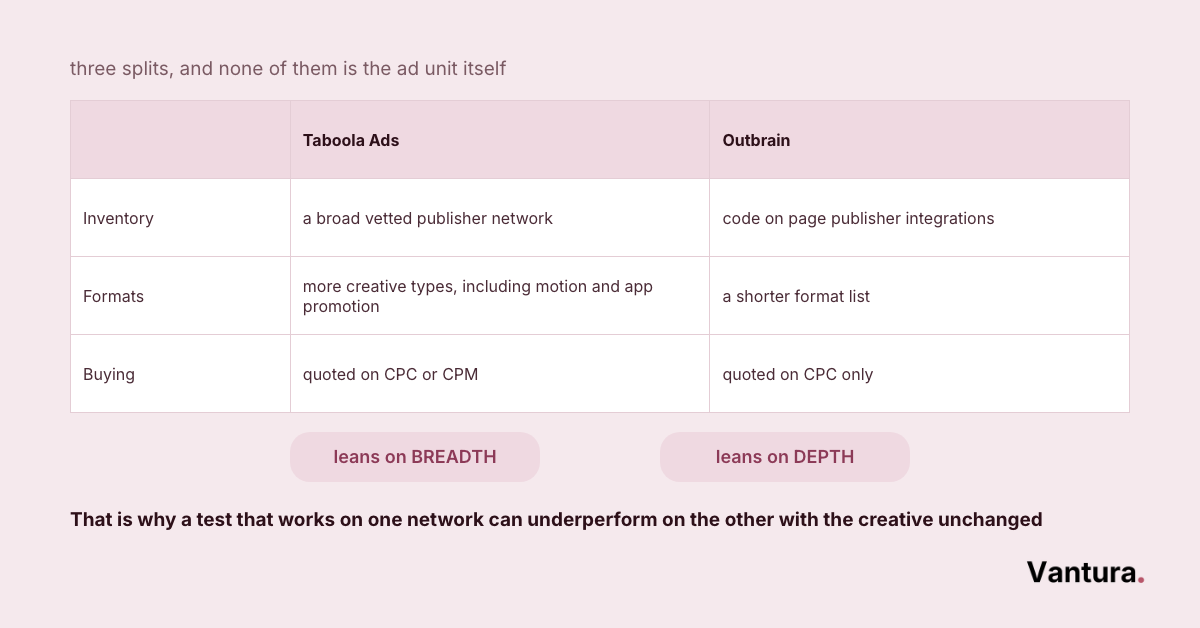
The gap shows up in three places, and none of them is the ad unit itself.
- Inventory: Taboola sells a broad vetted network, Outbrain sells code on page publisher integrations
- Formats: Taboola lists more creative types, including motion and app promotion ads
- Buying: Taboola quotes CPC or CPM, Outbrain quotes CPC only
For campaigns like ecommerce native campaigns that need lots of creative variants, the wider format list earns its keep. For a considered purchase, placement quality usually matters more.
Traffic quality tends to track the same split, in our experience running both networks side by side. Outbrain’s code on page integrations put the ad inside a smaller set of pages, so sessions referred from it tend to stick around longer than the broader, faster clicks Taboola’s wider network pulls in.
Where they split: Taboola Ads leans on breadth, more formats and more inventory fed by automated matching. Outbrain leans on depth, fewer partners but tighter page integrations. That’s why a test that works on one network can underperform on the other without the creative changing at all.
Taboola Ads vs Outbrain: What’s Similar?
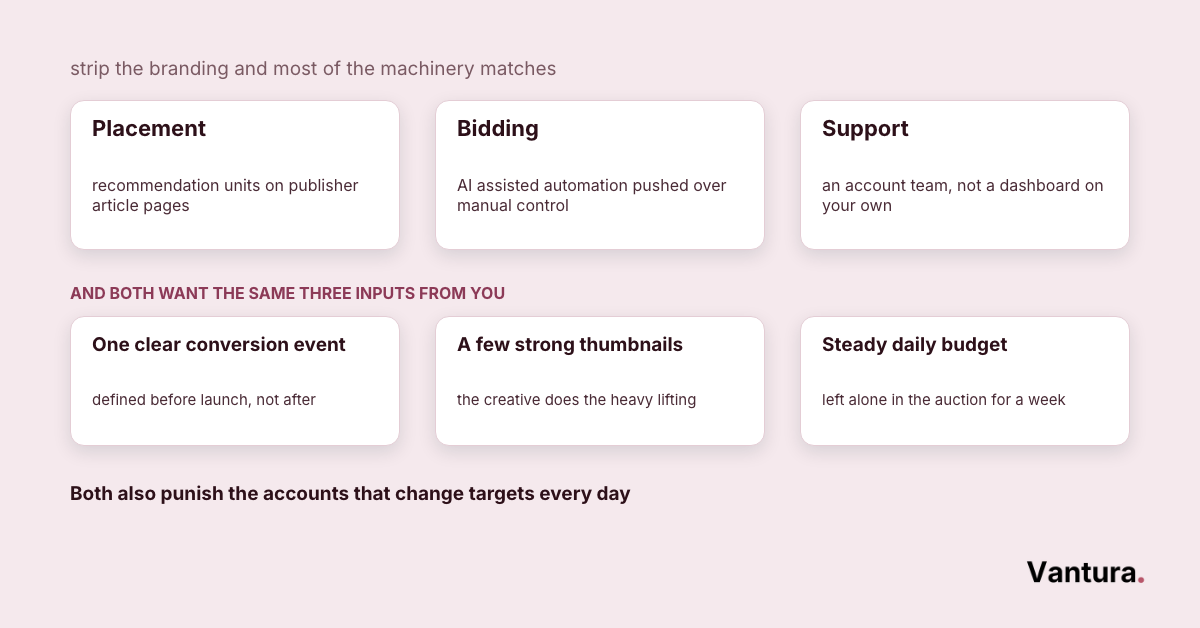
Strip the branding and most of the machinery matches.
- Placement: both run recommendation units on publisher article pages
- Bidding: both push AI assisted automated bidding over manual control
- Support: both include an account team rather than leaving you alone in a dashboard
Reporting looks familiar across the two as well. Anyone comparing dashboards for Taboola Ads integrations work will find the other readable within a session.
Common ground: Both networks want the same three inputs from you. That means a clear conversion event, a few strong thumbnails, and enough daily budget to leave the auction alone for a week. Both also punish accounts that change targets every day.
How Does Taboola Ads Work in Comparison to Outbrain?
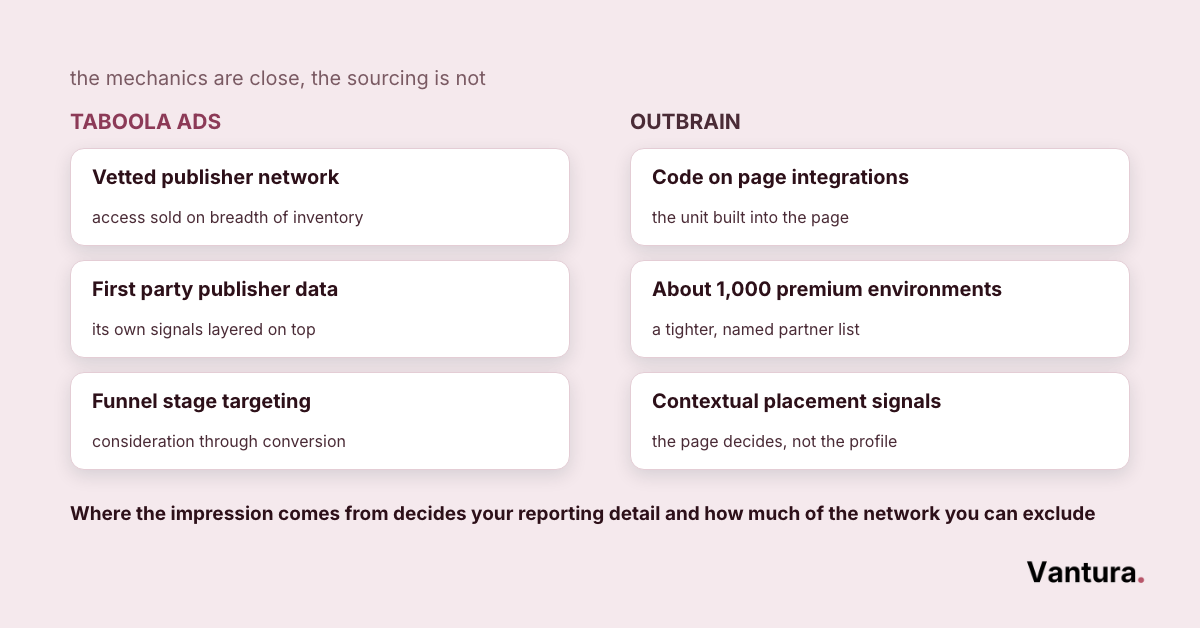
The mechanics are close, but the sourcing is not. Where the impression comes from shapes everything downstream, from reporting detail to how fast a campaign settles.
Where the inventory comes from
Taboola sells access to a vetted publisher network and layers its own first party publisher data on top. Outbrain publishes a different claim, code on page integrations with 10,000 media partners across about 1,000 premium media environments.
That difference is not marketing gloss. It changes how granular your placement reporting gets and how much of the network you can exclude.
Taboola Ads
Reach is the selling point here. The network spans a wide set of vetted publishers rather than a short partner list.
- Broad vetted publisher inventory
- Proprietary first party publisher data
- Consideration and conversion funnel targeting
- High intent user identification built in
Outbrain
Outbrain sells the integration rather than the headcount of publishers. The unit is built into the page rather than dropped onto it.
- Code on page integrations with media partners
- Around 1,000 premium media environments
- Contextual insights feeding placement decisions
- Real time reporting in the advertiser dashboard
How targeting and bidding are handled
Both hand the bid to a model and ask you to feed it a clean conversion signal. Taboola frames this as AI audience matching trained on well over a decade of network data. It’s the part most new accounts fight, which is where a Taboola Ads consulting review usually starts.
Outbrain describes predictive AI aimed at the most responsive audiences, sitting on top of contextual signals. The practical effect is the same in both cases. You get less manual control than search buyers expect, and patience beats tinkering.
Taboola Ads
The controls sit around the funnel stage you’re buying. You point the system at consideration or conversion and let the matching do the rest.
- Funnel stage targeting for consideration or conversion
- AI matching against publisher first party data
- High intent identification across the network
- CPC or CPM buying, chosen per campaign
Outbrain
Context does more of the work. The bid follows the page the reader is on as much as the reader themselves.
- Contextual insights driving placement
- Predictive AI handling automated bidding
- Signals processed across the partner network
- Cost per click buying only
How the creative gets made
Native burns creative faster than any channel we run. A thumbnail that pulls in week one is often flat by week three, so the tooling around creative matters more than it looks.
Taboola built a GenAI AdMaker suite for adapting creative. Outbrain publishes a shorter format list instead and leaves production to you.
Taboola Ads
More formats mean more shots at the same offer. That helps if you have the capacity to fill them.
- Native, display and social creative
- Vertical video, carousel and motion ads
- App promotion formats
- GenAI AdMaker for adaptation
Outbrain
The list is shorter and the decisions are quicker. Fewer options is not automatically worse when your creative team is two people.
- Standard Native for article style placements
- Clip for video led campaigns
- Carousel for multiple products in one unit
- App Install for mobile acquisition
Taboola Ads Pricing vs Outbrain Pricing
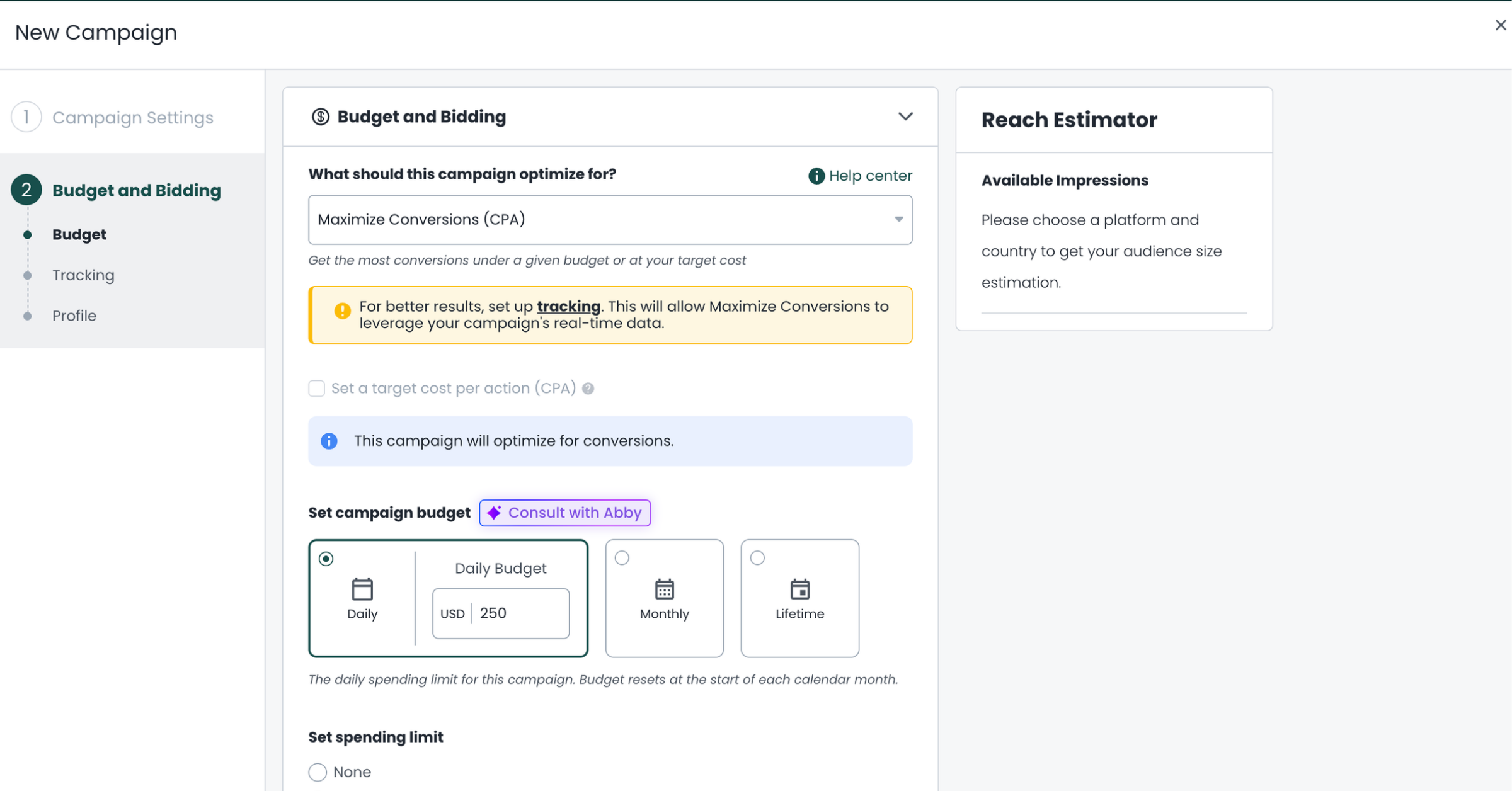
Neither company publishes a rate card, so anyone quoting you an exact Taboola or Outbrain click price is guessing. What you can compare is the buying model, and that comparison is where a Taboola Ads alternatives review of current spend tends to begin.
Taboola Ads pricing on the Realize platform
Taboola gives you two ways to buy. Price is set in the auction, not by a plan tier you sign up for.
- Cost per click or cost per thousand impressions
- No published price list on the official site
- No public plan tiers or contracts to compare
- Cost moves with click rate, audience and publisher mix
Outbrain pricing under Outbrain Direct Response
Outbrain is simpler on paper. Its advertiser materials describe cost per click buying, again with nothing published as a fixed rate.
- Cost per click buying only
- No published price list on the official site
- Third party minimum budget figures go stale fast
- Current terms come from your account team, not a blog post
What native ads really cost you
Across our native accounts, a readable test usually needs roughly 60 to 90 dollars a day for about two weeks on either network. Anything thinner reads as noise, which is the most common reason a first native test gets written off.
Budget reality: Because both networks price in a live auction, the number that matters is not the click price you’re quoted. It’s the cost per qualified action after two weeks of steady spend. That figure moves far more with creative and landing page than with the choice between Taboola Ads and Outbrain.
Who Is Taboola Ads Best For?
Taboola Ads suits advertisers who need volume before they need precision. That’s why it turns up so often in health and wellness accounts. The wide format list gives you more ways to test a single offer.
It also rewards teams with creative capacity. Taboola built its GenAI AdMaker suite because native placements go stale fast, and accounts that can’t refresh weekly tend to stall.
Taboola Ads fit and misfit
- Broad top of funnel offers with wide appeal
- Teams shipping new creative every week
- Ecommerce catalogues and app installs
- Buyers who want CPM as well as CPC
- Accounts with room to test and discard
- Budgets too small to survive a learning period
- Regulated offers with tight placement rules
- Brands needing named publisher control
- One creative, run forever
- Teams expecting search style manual bidding
Who Is Outbrain Best For?
Outbrain fits advertisers who care where the ad sits more than how many places it can sit. That’s the pattern across most finance sector accounts we run. Its code on page integrations mean the unit is built into the publisher’s page rather than bolted beside it.
That suits considered purchases and longer sales cycles. Fewer, better placed impressions beat a wide net when the buying decision takes weeks.
Outbrain match and mismatch
- Considered purchases with long research cycles
- Content led campaigns pointing at articles
- Brands sensitive about surrounding context
- Buyers happy with click based pricing
- Accounts that value a named account team
- Advertisers who need every native format
- Teams that want impression based buying
- Campaigns chasing raw volume above all
- Very short flights with no ramp time
- Offers built around app store installs alone
Does Taboola Ads Have Better Features Than Outbrain?
Better depends on what you’re buying. On raw feature count Taboola is ahead, but count is not the same as fit.
Where Taboola Ads leads
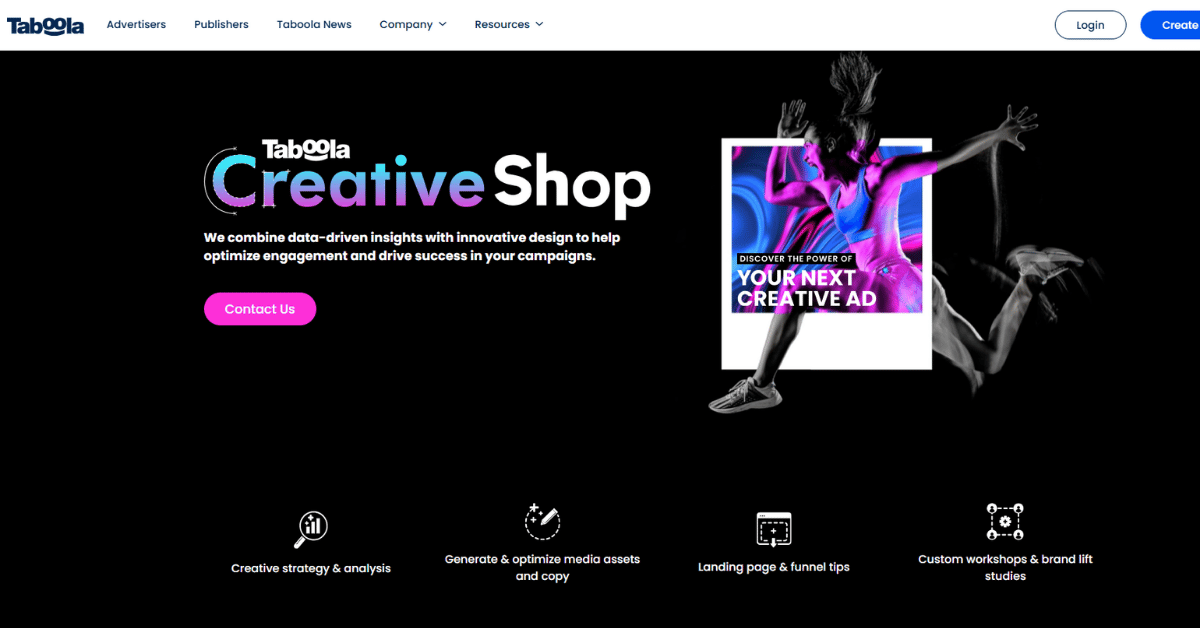
The format range is the clearest lead. Native, display, social creative, vertical video, carousel, motion and app promotion all sit in one account. A single offer can be tested seven different ways.
The buying model is the second. Being able to switch between click and impression pricing changes what you can do with an awareness budget. It’s one of the first things we set up on a new Taboola Ads agency handover.
Creative tooling closes it out. The GenAI AdMaker suite exists because refresh cadence is the constraint on most native accounts, not budget.
Where Outbrain leads
Outbrain’s lead is structural rather than feature by feature. Code on page integrations with its media partners put the ad inside the article layout. It’s not a widget hanging off the bottom.
Its targeting story is contextual first. Predictive AI handles the bidding, but the signal it reads starts with the page rather than a rebuilt profile of the reader.
Account support rounds it off. An expert management team comes with the buy, and the dashboard reports in real time. That’s the difference between catching a bad flight on day two and on day nine.
So which feature set wins?
Taboola wins on paper because it hands you more levers, and more levers help while you’re still hunting for the offer that works. Outbrain wins once you know the offer and want each impression to land somewhere sensible.
Feature call: More formats only pay off if you have the creative to fill them. Treat Taboola Ads as the better fit for teams still in test mode. Treat Outbrain as the better fit for accounts with a settled offer that needs the right page, not more pages.
Is Taboola Ads Easier to Use Than Outbrain?
Not by much. Both put campaign setup, targeting and reporting in one dashboard. Both also include an account team, so neither leaves you reading docs alone.
Outbrain’s shorter format list makes the first setup quicker. Taboola gives you more to configure, which helps later and slows you on day one.
What Do the Taboola Ads and Outbrain Rebrands Change?
Less than the name changes suggest, but not nothing. Both brands moved recently, so old notes won’t match the login screens or the paperwork.
Reading the Realize rebrand
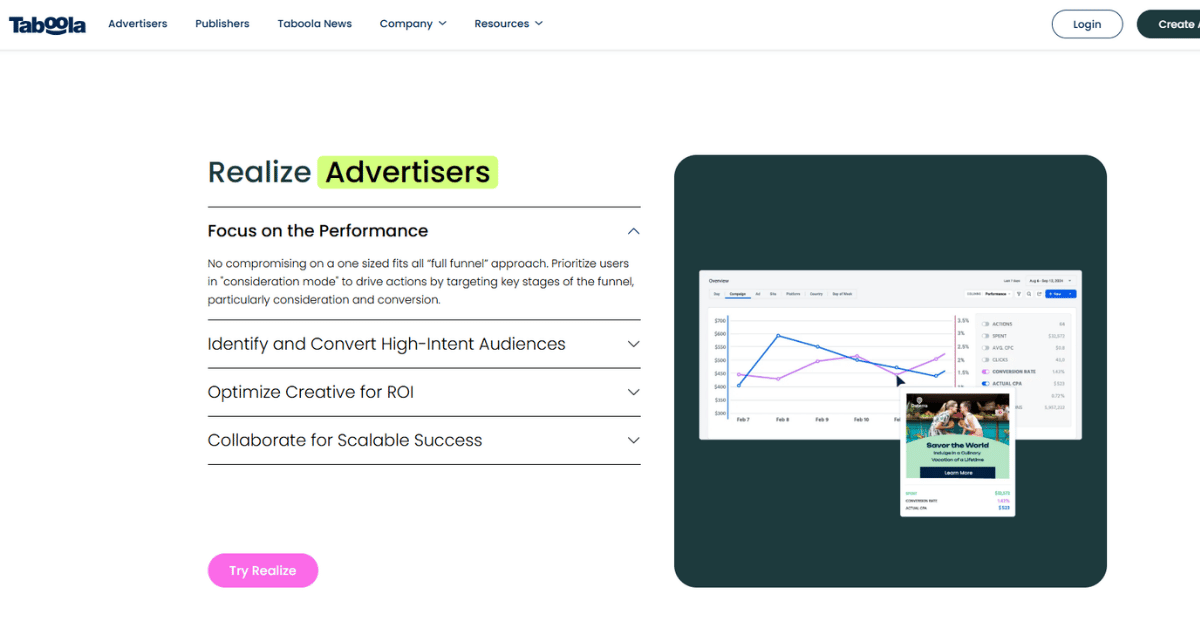
Taboola’s self serve advertiser product now carries the Realize name. The company positions it as the way to scale beyond search and social, which tells you exactly who it’s aimed at.
None of that changes the auction you were already buying in. It changes the signup path, the help articles, and the name your finance team sees.
Same auction, new label
Campaign structures carry over. A working Taboola setup didn’t reset when the brand changed.
What did move is the surrounding tooling. Creative features like the GenAI AdMaker now sit under the new name, so older internal guides point at pages that shifted.
Where the documentation moved
Signup and help content live on Realize properties now rather than the older advertiser pages. Most bookmarks redirect, but not all of them do.
What Teads ownership changes for Outbrain buyers
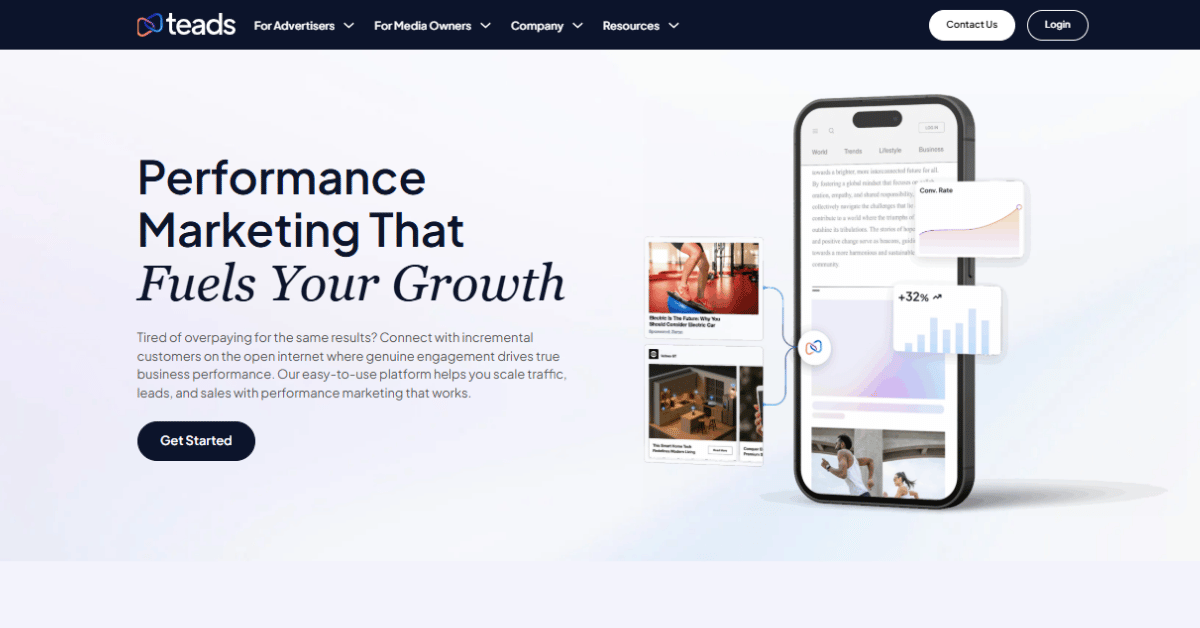
Outbrain completed a merger with Teads and renamed the parent company Teads Holding Co. The advertiser product you buy is still Outbrain, sold as Outbrain Direct Response.
So the brand on the invoice may not match the brand in the dashboard. That trips up procurement more often than media teams. It’s the kind of detail a Taboola Ads vs AdRoll comparison picks up early.
Who owns the roadmap now
Product direction sits with a larger parent than before. For buyers that mostly shows up as more inventory conversations and fewer standalone product announcements.
None of that is a reason to move budget on its own. Judge it on the numbers you’re already seeing in the account.
What to ask your account team
Ask which entity you’re contracting with, and whether your placement controls survive any inventory changes. Those two answers cover most of the practical risk.
Taboola Ads and Outbrain Compared Against the Competition
Neither network is bought in isolation. Most budget arguments we sit in put native against three other options rather than against each other.
MGID vs Taboola Ads and Outbrain
MGID comes up whenever entry cost is the constraint. In the accounts we’ve moved, the trade is usually inventory quality for a cheaper start.
Some offers survive that trade and some don’t. Broad consumer offers tend to hold up, while anything needing a credible surrounding page generally doesn’t.
Google Ads vs Taboola Ads and Outbrain
Search captures demand that already exists. Native creates it, which is why we rarely see the two competing for the same budget line.
If your category has search volume, spend there first. Native earns its place once search is saturated and you need a fresh source of first touches for niche audiences.
Meta ads vs Taboola Ads and Outbrain
Paid social and native both interrupt. The difference is context, a feed versus an article page, and that changes which creative works.
Across our accounts, native traffic arrives in reading mode. That favours longer landing pages, where social traffic usually wants the offer near the top.
What Do Taboola Ads and Outbrain Do About Ad Quality and Brand Safety?
Reach and format range get most of the attention in a Taboola Ads and Outbrain comparison, but the pages your ad actually lands beside matter just as much. Native inventory carries a different risk profile than search or social, and both networks handle that risk differently.
How each network screens the pages your ad lands on
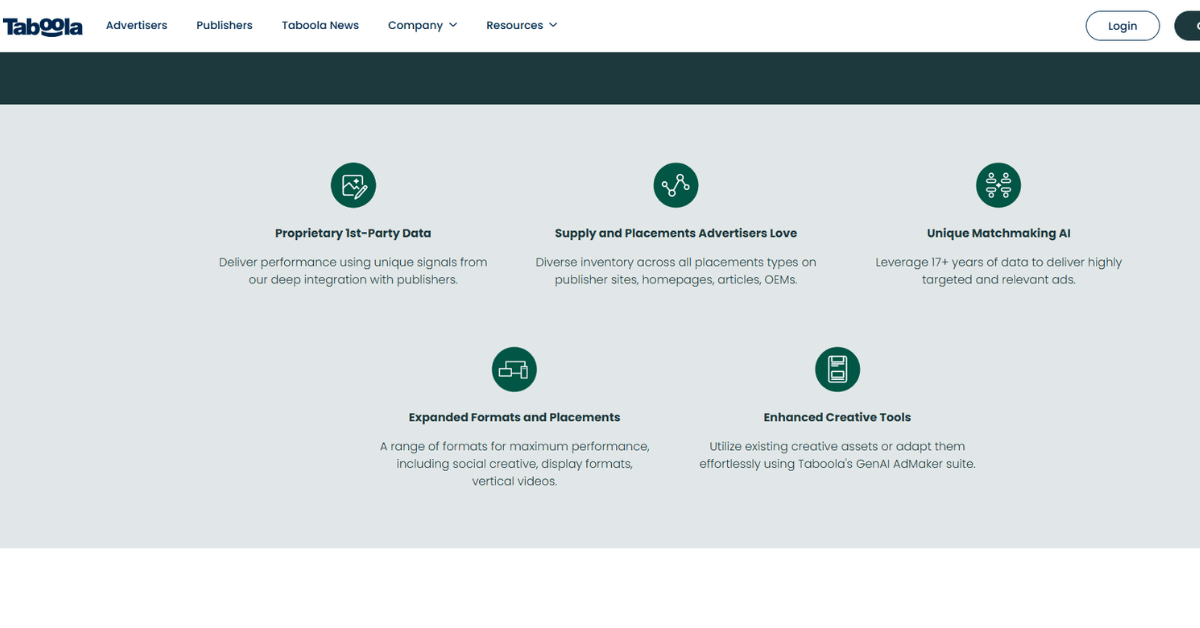
Taboola’s vetting runs through the same proprietary first party publisher data that feeds its targeting. A page has to clear that bar before it can carry a campaign, which is part of why the network can promise broad reach without opening the door to any site that asks.
Outbrain works the opposite direction. Its code on page integrations mean the unit is built directly into a smaller, named set of publisher pages, so there’s less unknown inventory to police in the first place.
Why this shows up in more than your click-through rate
Native carries the highest invalid traffic rate of any major channel, a 15.9 percent invalid traffic rate, roughly seven times the 2.18 percent rate search sees. That figure covers the whole channel, not either brand specifically, but it’s the reason publisher vetting is worth checking before you judge a campaign’s numbers.
A campaign that looks weak on cost per click can just as easily be a fraud problem as a creative problem. Pulling a placement report before you rewrite the ad usually settles which one it is.
None of that means every placement report reads the same way. Some accounts get campaign level totals only, others break results down by the exact publisher domain a click came from.
That level of detail is what turns a vague “results are weak” into a specific, fixable placement problem.
What a detailed placement report shows
A domain-level report lists cost, clicks and conversions per publisher, not just per network. One or two sites dragging down the whole account average become obvious the moment you sort by cost per action.
Pull that report before touching the creative. In our experience, a handful of underperforming domains explains more weak results than the ad itself does.
What good and bad campaigns tend to have in common
Across the native accounts we’ve run, the campaigns that hold up share one habit. Someone checks the placement report in week one, not week four.
The ones that don’t hold up usually skipped that step. By the time anyone notices the cost per action drifting, the budget that funded the drift is already spent.
The setting most accounts never touch
Both networks let you exclude specific publishers or categories from a campaign, and most advertisers never open that menu. It costs nothing to use and it’s the fastest way to stop a repeat offender.
Review the exclusion list every few weeks rather than once at setup. Inventory changes, and a placement that performed fine last quarter can quietly turn into your worst one.
Exclusion lists only work if someone actually checks them against the account’s own numbers, not just a generic blocklist someone copied years ago.
That review takes minutes once it’s part of the routine, and it’s the difference between an account that quietly improves and one that quietly leaks budget.
Who should own this check each month
On accounts we manage, whoever owns the media buy also owns the exclusion review. Splitting the job across two people means it quietly stops happening.
A recurring fifteen minute check beats an occasional deep audit, since fraud and weak inventory tend to show up gradually rather than all at once.
How Do You Test Taboola Ads Against Outbrain Fairly?
You hold everything constant except the network. Most native comparisons die in the setup, not in the auction.
If the two accounts measure different things, the winner is whichever one you tracked better. A documented approach, the kind we lay out in our Taboola Ads vs Criteo comparison, is what stops that happening.
Set the test up before you set the budget
Pick one conversion event and define it identically on both sides. A lead form on one and a page view on the other hands you a result that means nothing.
Then hold everything else still. Same landing page, same offer, same creative set, same daily budget, for the same number of days.
- One conversion event, defined the same way on both
- Identical landing page and offer
- The same creative set on each network
- Equal daily budget over equal days
- No edits once the flight starts
Before you spend: Write the success threshold down before launch, a cost per action you’d be happy to pay. Agree it with whoever controls the budget. A test with no pass mark always ends in an argument about whether the numbers were good.
Two ways to split the budget
You can run both at once or one after the other. Neither is wrong, and the pick follows budget, which is why insurance sector programs default to parallel while smaller accounts can’t.
Running in parallel gives a cleaner read on the same market conditions. Running back to back gives each network a full budget, which matters when the daily spend is thin.
Both networks run at the same time on half budget each. Seasonality, news cycles and competitor spend hit both, so the comparison is fair.
The cost is thinner data on each side. Small budgets split in two can stall before either network settles.
One network runs to a conclusion, then the other takes over. Each gets full budget and a proper ramp.
The cost is that the market may have moved between flights. A big gap between the two deserves a re run before you act on it.
What to do once one network pulls ahead
A clear winner is rarely the end of it. Before you move all the budget, check the gap holds when you strip out one big day.
#1 Confirm the gap
Run the winner alone for a week at full spend. If the cost per action holds, it was real.
#2 Keep a floor on the loser
Leave a tenth of the budget running. Inventory shifts, and a dead account is slow to restart.
#3 Rebuild creative before scaling
Native fatigue arrives fast. Refresh thumbnails and headlines before you triple the budget, not after.
The Taboola Ads vs Outbrain Verdict
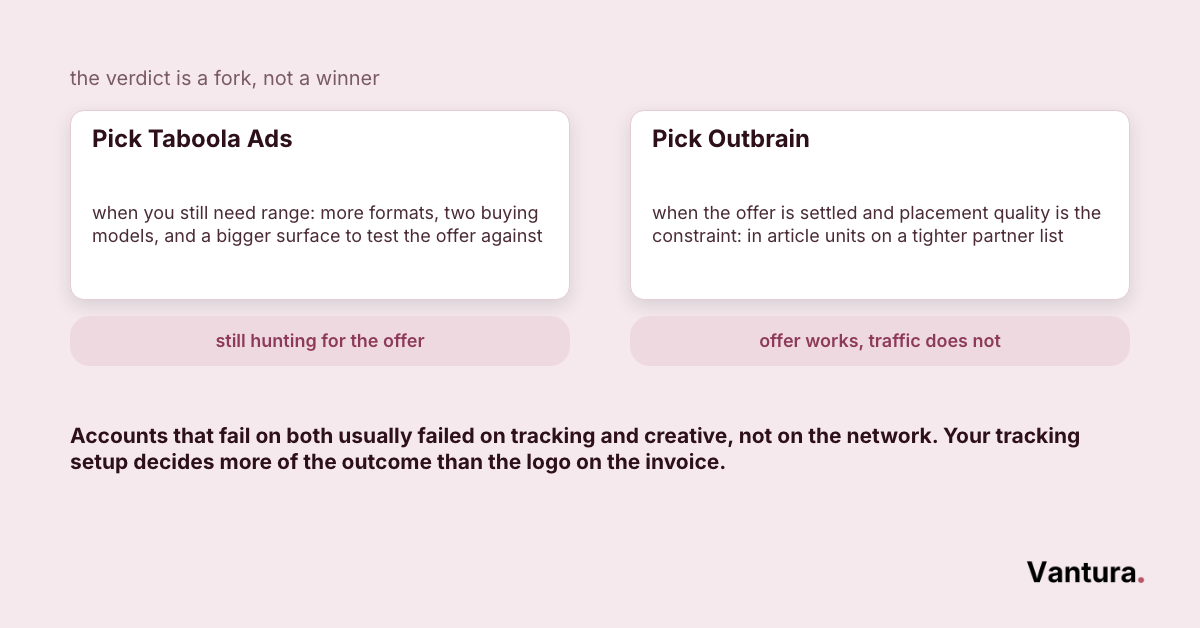
Taboola Ads wins on breadth. More formats, two buying models, and a bigger surface to test against.
Outbrain wins on placement quality. Code on page integrations and a tighter partner list put your ad inside the article rather than beside it.
If you’re still hunting for the offer, start with Taboola. If the offer works and the traffic doesn’t, Outbrain is the better second stop.
Neither is a bad buy. The accounts that fail on both usually failed on tracking and creative, not on the network.
Bottom line: Pick Taboola Ads when you need range and expect to test hard. Pick Outbrain when the offer is settled and placement quality is what’s holding results back. Remember that your tracking setup decides more of the outcome than the logo on the invoice.
Taboola Ads vs Outbrain FAQ
Disclaimer: This post is for informational purposes only and reflects our own experience running native advertising campaigns. Product details, pricing models and brand ownership can change at any time, so verify current terms with Taboola and Outbrain directly before committing budget. Vantura Marketing accepts no liability for decisions made on the basis of this content.